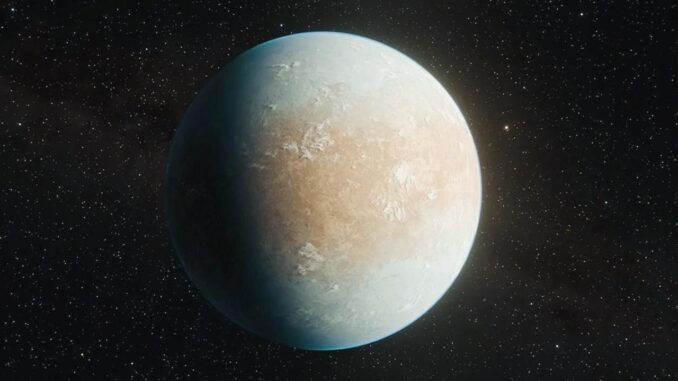
On the frontier of astronomical research, recent findings have ignited excitement about the potential for extraterrestrial life and habitable worlds beyond our solar system. For decades, astronomers have scoured the cosmos for planets that resemble Earth not just in size but in conditions capable of supporting life. Now, cutting-edge observations are revealing a promising candidate that aligns with all the critical criteria expected in a potentially life-supporting planet.
Advanced telescopes and observational technology have led to the detection of a celestial body orbiting a star named HD 137010. This star, situated hundreds of light-years away, hosts a planet that displays characteristics remarkably similar to our home planet. This discovery is not merely about size or orbit; it marks a significant step toward answering one of humanity’s oldest questions: Are we alone?
The planet, designated as HD 137010b, orbits its star within the so-called “habitable zone,” where conditions could allow liquid water to persist on its surface. While initial data pulls back the curtain on its physical attributes—such as size and orbital dynamics—scientists are eager to analyze its atmosphere, surface composition, and potential biosignatures.
## Characteristics of the Star and Its Planetary Companion
The star HD 137010 is classified as a G-type main-sequence star, similar in size and temperature to our Sun. It exhibits steady luminosity, which is essential for providing stable energy input to any orbiting planets. The planet HD 137010b is approximately 1.1 times larger than Earth, suggesting a rocky, terrestrial composition. Its orbital period ranges between 300 and 555 days, indicating a moderate distance from its star that falls within the optimal range for habitability.
Measurements imply that the planet’s surface gravity and size could support a thin to moderate atmosphere, which is crucial for temperature regulation and potential life processes. The distance from the star makes it unlikely for the planet to experience extreme temperature variations, unlike planets that orbit too closely or far from their stars.
The orbit’s stability suggests that HD 137010b could have maintained its position for billions of years, allowing enough time for potential biological evolution should the conditions be right. The star’s relatively low activity level also minimizes harmful solar radiation, creating a more favorable environment for delicate biological systems to develop.
## Conditions Favoring Habitability
Key indicators of habitability include the planet’s size, orbit, and the star’s energy output. In this case, HD 137010b’s size and orbit place it squarely within the habitable zone, where temperatures could sustain liquid water — a vital ingredient for life as we know it.
However, one of the greatest uncertainties remains the composition and density of the planet’s atmosphere. An atmosphere rich in greenhouse gases like carbon dioxide or methane could trap heat and raise surface temperatures to comfortable levels, making it more conducive to life.
Moreover, the planet’s surface features—such as landmass distribution, ocean presence, and chemical makeup—are still under investigation. Are there vast oceans capable of supporting marine life? Does the surface have volcanic activity that could enrich the atmosphere with essential gases? These questions remain pivotal in determining the true habitability of HD 137010b.
## Technological Efforts to Uncover More
State-of-the-art observatories like NASA’s TESS (Transiting Exoplanet Survey Satellite) and ESA’s CHEOPS (Characterising Exoplanet Satellite) play critical roles in such discoveries. These satellites analyze the light curves of stars to detect minute dips caused by planets passing in front of their stars.
Upcoming missions like the James Webb Space Telescope are expected to offer unprecedented insights into atmospheric composition through spectroscopic analysis. Detecting gases such as oxygen, ozone, or methane could provide evidence of biological processes or even primitive life.
Ground-based observatories contribute by refining the planet’s orbital parameters and surface characteristics. As data accumulates, models of the planet’s climate and surface environment become increasingly reliable, narrowing the gap toward confirming whether conditions are truly life-friendly.
## Implications for Humanity and Future Exploration
The discovery of HD 137010b marks a pivotal milestone in our quest to find extraterrestrial life. It pushes the boundaries of what we consider possible, urging the scientific community to prioritize detailed atmospheric analysis and surface characterization.
With technological advancements, the next steps involve deploying specialized probes and imaging equipment to acquire high-resolution data. The hope is to identify biosignatures or environmental markers that indicate life or habitable conditions.
This discovery also accelerates the search for additional planets within this star’s system. If HD 137010b is indeed capable of supporting life, orbital dynamics might permit the existence of other, yet-undetected planets with even more promising conditions.
Understanding these distant worlds doesn’t just satisfy curiosity; it reshapes our perspective on life’s rarity or abundance in the universe. Each new finding, like HD 137010b, brings us closer to answering whether Earth is a unique oasis amid the cosmic wilderness or just one of many habitats hosting lifeforms across galaxies.