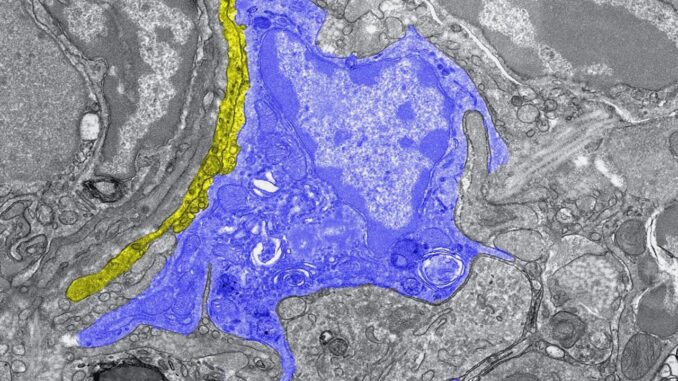
Imagine a small bird, thousands of miles away from its nesting grounds, flying confidently across a stormy, pitch-dark night. How does it do that? For centuries, scientists have believed that migratory birds and even carrier pigeons rely on the Earth’s magnetic field to find their way. Yet, the precise biological mechanisms behind this extraordinary sense remained a mystery—until now. Recent groundbreaking research has uncovered that magnetic sensing in birds is deeply rooted in their liver’s immune cells, specifically those overloaded with iron. This discovery not only rewrites our understanding of avian navigation but also sheds light on how other animals might perceive Earth’s magnetic field. ### The Long-Standing Mystery of Avian Navigation For decades, scientists proposed three main theories explaining how birds perceive magnetic fields: – Magnetic particles in the upper beak, acting as tiny compass needles. – Ion channels within nervous system cells, responding to magnetic stimuli. – Light-dependent mechanisms in the retina, where specialized cells interpret magnetic cues. Despite extensive research, each hypothesis faced limitations, especially during overcast skies or in total darkness, when visual cues become unreliable. Birds’ consistent navigation despite adverse conditions hinted at an additional, perhaps more fundamental, mechanism. ### The Liver’s Secret Role: Iron-Rich Immune Cells as Magnetic Sensors A team from Bonn University led by Dr. Clivia Lisowski delved into the biological composition of migratory birds’ organs. They identified that the liver’s immune cells, known as macrophages, accumulate significant amounts of iron. This accumulation creates a natural magnetic field within the liver. Using advanced laboratory techniques, the researchers demonstrated that: – These iron-laden macrophages exhibit magnetic responsiveness. – When stimulated, they generate magnetic signals that can be transmitted to the bird’s nervous system. – Temporary suppression of these cells leads to disorientation outside visual or celestial cues. This evidence strongly suggests that the liver functions as a biological magnetometer, providing essential directional information even in complete darkness. ### How Do These Magnetic Signals Travel to the Brain? The research illustrates that the magnetic signals generated by the liver are relayed via neural pathways to the bird’s brain, particularly to the hippocampus, which is crucial for navigation and spatial memory. Furthermore, experiments involving chemical interference with iron accumulation showed that birds lost their innate ability to orient when their liver’s magnetic sensing capability was compromised. They only regained their orientation skills once the interference was removed, and normal iron levels were restored. ### Implications for Broader Biological and Technological Fields This research extends beyond ornithology. It suggests that many animals might possess similar biochemical systems for magnetic sensing, ranging from marine mammals like whales to earthworms. It also ignites interest in developing bio-inspired navigation systems in robotics and autonomous vehicles, replicating this natural magnetic sensing mechanism. ### What Sets This Finding Apart? While previous theories relied heavily on magnetite particles or visual cues, this discovery emphasizes that internal organs rich in iron can serve as biological magnetic sensors. It explains how birds maintain their navigational precision even during adverse weather or in dark environments, where visual cues are absent. ### Future Directions and Questions – Do similar mechanisms exist in other migratory animals? – How does this liver-based system interact with known visual and magnetic receptor theories? – Can we manipulate these iron-rich cells to influence animal navigation? This breakthrough opens exciting avenues for biomedical research and wildlife conservation, especially as human activities increasingly threaten migratory routes and natural habitats. Understanding the innate magnetic sensing capabilities of animals adds a vital piece to the puzzle of nature’s complex navigation repertoire.