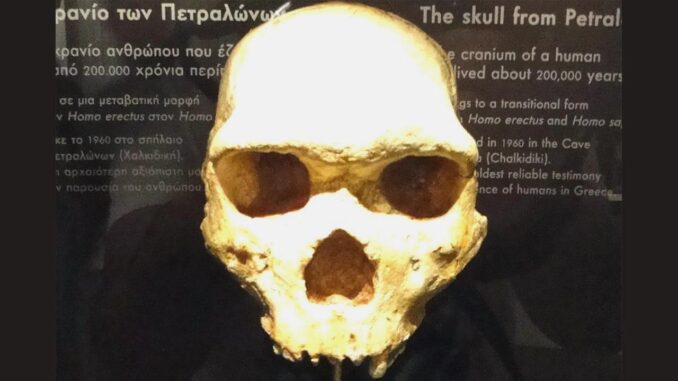
Deep within the rugged mountains of Thessaloniki, a discovery was made that would challenge our understanding of human evolution. The Petralona Skull, excavated from a mysterious limestone cavern, has sparked debates that continue to this day. This ancient skull isn’t just a relic; it’s a window into a pivotal era, revealing complex stories about our ancestors and the intricate web of human ancestry. As researchers delve into its details, new questions emerge, pushing the boundaries of what we know about where we come from and how we evolved.
The Petralona Cave, where this significant find was unearthed, offers more than just a backdrop for history—it provides a preservation environment that has kept the skull remarkably intact. Thanks to mineral-rich waters and stable conditions over tens of thousands of years, the fossil has withstood the relentless march of time. This natural preservation process has enabled advanced scientific techniques to analyze the skull’s morphology and age with high precision, offering invaluable insights into a period shrouded in mystery.
Discovery and Early Interpretations
When the fossil was discovered in 1960 by a local worker, it immediately attracted the attention of paleoanthropologists worldwide. Initial impressions leaned towards Homo erectus, based on the skull’s robust features and archaic traits. However, as research progressed, scientists realized that the Petralona Skull presented a unique blend of both primitive and modern characteristics. This duality raised significant questions: was it a transitional form? Could it belong to a previously unrecognized branch of human evolution?
The skull’s partial cranial capacity, estimated at about 600 cc, was smaller than most modern humans but larger than some early archaic humans. Its features, such as prominent brow ridges, a broad face, and a large jaw with thick bones, signaled a complex evolutionary background. Over time, the consensus shifted from a simple classification to a broader discussion about the diversity of hominin species in Eurasia during the Middle Pleistocene.
Unique Preservation and Geological Context
The cave’s limestone structure played a key role in protecting the skull from environmental deterioration. The mineral layers, especially the calcium carbonate deposits, enveloped the fossil in a natural cocoon, effectively shielding it from erosion and microbial decay. Such geological conditions are rare and highly valued in paleoanthropology because they allow for meticulous analysis of fossils that, elsewhere, would have long been lost or severely degraded.
Furthermore, the stratigraphic layers surrounding the find place it approximately 400,000 to 700,000 years ago, a crucial period for understanding human dispersal and evolution. This setting provides a timeline that helps scientists correlate morphological features with other regional fossils, creating a broader picture of evolutionary trends across continents.
Morphological Analysis and Evolutionary Significance
Modern 3D imaging and comparative analysis reveal that the Petralona Skull bears features characteristic of Homo heidelbergensis, a species thought to bridge the gap between Homo erectus and modern humans. Its prominent brow ridges, elongated cranium, and distinct facial structures suggest it might be a regional variant or an early representative of this transitional species.
Some scientists argue that this skull demonstrates interbreeding events or regional adaptations rather than representing a separate distinct species. The variability in cranial shape and facial projection underscores the likelihood of a complex evolutionary landscape, where multiple hominin groups coexisted and interbred over dozens of thousands of years.
Radiometric Dating and Age Determination
While initial dating placed the skull around 150,000 years old, recent advances in uranium-series dating techniques have pushed that estimate further back. Newly obtained data suggests an age of approximately 286,000 years, solidifying its place in a key era of human evolution. This period coincides with significant climatic shifts—the onset of ice ages—that likely influenced migration patterns, adaptation, and species development.
This advanced dating not only clarifies the timeline but also aligns the Petralona Skull with other significant Eurasian finds, forming a mosaic that depicts the migration and evolution of hominins across continents.
Implications for Human Ancestry and Migration
The discovery and subsequent studies of the Petralona Skull have profound implications for understanding Homo heidelbergensis’ spread into Europe and beyond. Its features suggest it could be part of the lineage leading to Neanderthals in Europe, or it could represent a parallel branch of early humans adapting to diverse environments.
Genetic studies, still in their infancy for such ancient specimens, support the idea that interbreeding and gene flow between different hominin groups—like Denisovans and Neanderthals—might have influenced the genetic makeup of modern humans. The Petralona site thus acts as a critical node in the broader network of human migrations during the Middle Pleistocene, providing clues about how our ancestors adapted to changing climates and landscapes.
Current Research and Future Directions
Ongoing research harnesses cutting-edge technologies such as micro-CT scans, isotopic analysis, and DNA extraction techniques to uncover more about its origins. Although retrieving genetic material from fossils this old remains a challenge due to DNA degradation, advances in ancient protein analysis offer promising avenues.
Scientists continue to explore the genetic lineage of the Petralona Skull, aiming to connect it more definitively with other regional fossils and to understand its precise place within the intricate web of human evolution. Furthermore, excavations nearby might reveal additional fossils that can shed light on the environmental factors and species interactions during that epoch.
Understanding the Petralona Skull as part of the broader narrative of human evolution is fundamental in unraveling the complex story of our origins. Its preservation, unique features, and the scientific debates it spurs highlight how each discovery deepens our knowledge and reshapes our understanding of where we come from, one ancient fragment at a time.