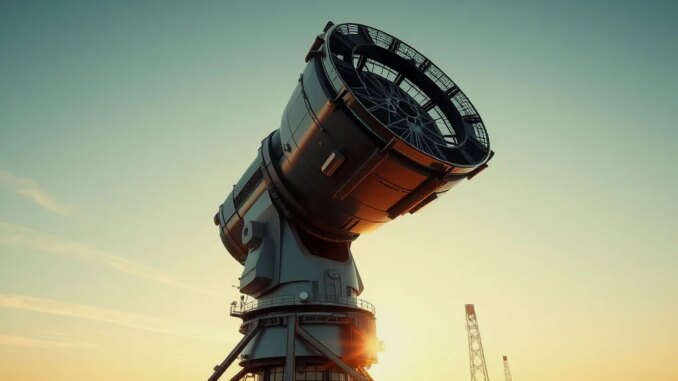
Unveiling the Universe with the Nancy Grace Roman Space Telescope
The Nancy Grace Roman Space Telescope, set for launch following its successful deployment on August 30th, promises to revolutionize our understanding of the cosmos. Unlike its predecessors, this state-of-the-art instrument is designed to gather unprecedented data that will illuminate the mysteries of dark matter, dark energy, and the vast populations of exoplanets. Its advanced imaging capabilities position it to become a cornerstone in modern astrophysics, offering insights that could reshape physical cosmology and our comprehension of the universe’s fundamental structure.
The Mission’s Unique Approach: Wide Field Imaging and Precision
Roman’s core strength resides in its ability to perform wide field surveys with extraordinary accuracy. The telescope boasts a 2.4-meter primary mirror coupled with a 300-megapixel near-infrared camera, enabling it to capture expansive sections of the sky with high resolution. This combination allows Roman to scan billions of galaxies and star systems each month, providing robust statistical samples necessary for testing cosmological models and refining our understanding of universe expansion.
Moreover, Roman’s design ensures a synergy with existing and upcoming space telescopes such as the Hubble and James Webb, fostering collaborative observations that maximize scientific returns. By systematically charting the sky, Roman will identify promising targets for in-depth spectroscopic analysis, paving the way for breakthroughs in understanding the makeup and evolution of cosmic structures.
Step-by-Step Strategy for Maximizing Data Collection
Roman’s operational workflow hinges on a meticulously planned observation strategy that excels in efficiency and effectiveness:
- Initial Wide Field Surveys: Target predetermined regions of the sky to gather broad, high-quality images, focusing on areas rich in galaxy clusters, supernovae, and potential exoplanet candidates.
- Automated Candidate Identification: Use sophisticated algorithms to analyze images, detecting brightness variations, motion, and color changes indicative of phenomena like exoplanet transits, supernova explosions, or variable stars.
- Prioritized Follow-Ups: Flag the most intriguing objects for detailed spectroscopic analysis by Roman or other telescopes, such as James Webb, ensuring the best scientific return per observation time.
- Iterative Data Refinement: Continuously update target lists based on incoming data, expanding the scope of discoveries and enabling rapid response to transient events.
Fueling Exoplanet Discoveries: From Thousands to Hundreds of Thousands
One of Roman’s most ambitious goals is to study the population of exoplanets across billions of stars in our galaxy. Traditional methods like radial velocity and transit surveys have identified a few thousand exoplanets to date. Roman aims to elevate this number to over 100,000 by leveraging its wide-field infrared imaging, which excels at detecting smaller planets orbiting distant stars.
This leap hinges on its ability to detect minute dips in stellar brightness caused by transiting planets, even in densely populated star regions. The telescope will monitor large fractions of the Milky Way, capturing millions of light curves that enable statistical analyzes of planetary frequency, size distribution, and orbital characteristics. Such comprehensive catalogs will feed into refined models of planetary system formation and habitability.
Mapping Dark Matter with Unmatched Precision
The elusive dark matter makes up approximately 27% of the universe’s mass-energy content, yet remains undetectable by direct observation. Roman’s deep, wide-field imaging offers a revolutionary method to map its distribution: gravitational lensing.
Through measurement of weak lensing effects across billions of galaxies, Roman can detect slight distortions in their shapes caused by the gravitational influence of dark matter clumps. This statistical approach allows scientists to construct detailed three-dimensional maps of dark matter’s distribution on cosmic scales, revealing how it influences galaxy formation and the large-scale structure of the universe.
Combining lensing data with galaxy clustering and redshift information, Roman will help answer fundamental questions about what dark matter is, how it interacts, and its role during various cosmic epochs.
Probing Dark Energy to Understand Cosmic Acceleration
Dark energy, which is responsible for the accelerated expansion of the universe, remains one of the greatest mysteries in cosmology. Roman’s high-precision measurements of distant supernovae and baryon acoustic oscillations (BAO) will shed light on whether dark energy is a constant or evolves over time.
By observing thousands of Type Ia supernovae at vast distances, Roman will precisely measure their brightness and redshift, constructing an accurate history of the universe’s expansion. Simultaneously, analysis of BAO signals in the large-scale distribution of galaxies will provide independent cross-checks, constraining the nature of dark energy’s equation of state parameter (w).
This comprehensive approach will clarify whether dark energy is akin to Einstein’s cosmological constant or if it stems from a dynamic field, influencing theories about the ultimate fate of the universe.
Synergizing with James Webb for Ultimate Cosmic Insights
The collaboration between Roman and James Webb Space Telescope (JWST) creates a synergy that maximizes scientific insights:
- Roman’s discovery phase: Roman conducts wide-field surveys to identify rare or transient phenomena, like hidden exoplanets, supernovae, or galaxy clusters with peculiar properties.
- Prioritization and detailed scrutiny: Automated systems evaluate and prioritize targets based on potential scientific value.
- James Webb’s in-depth follow-up: JWST performs high-resolution spectroscopy and imaging on selected targets, unveiling their physical and chemical properties with unparalleled detail.
This approach ensures rapid, efficient utilization of observation time, enabling scientists to study a broader array of phenomena with both breadth and depth.
The Cutting-Edge Hardware That Powers the Roman Mission
| Component | Feature |
|---|---|
| Primary Mirror | 2.4 meters in diameter, ensures high light-gathering and stability |
| Near-Infrared Camera (WFI) | Over 300 megapixels, optimized for wide-field imaging across multiple filters |
| Field of View | Much wider than Hubble, enables all-sky surveys at unprecedented speed |
| Scientific Goals | Investigate dark matter structure, dark energy evolution, exoplanet populations, and large-scale galaxy formation |
Why Now is the Critical Moment for Roman
The Nancy Grace Roman Space Telescope arrives at a pivotal time in astrophysics. It bridges the gaps left by older telescopes by providing comprehensive, statistical data that refines existing models and uncovers new phenomena. As the first telescope designed explicitly to harness the power of wide-field deep space imaging, Roman will deliver data that can potentially open entirely new research avenues, challenge current theories, and set the foundation for future missions. Its launch signifies a leap towards a more complete, nuanced understanding of the universe, marking a new era in cosmic exploration.